
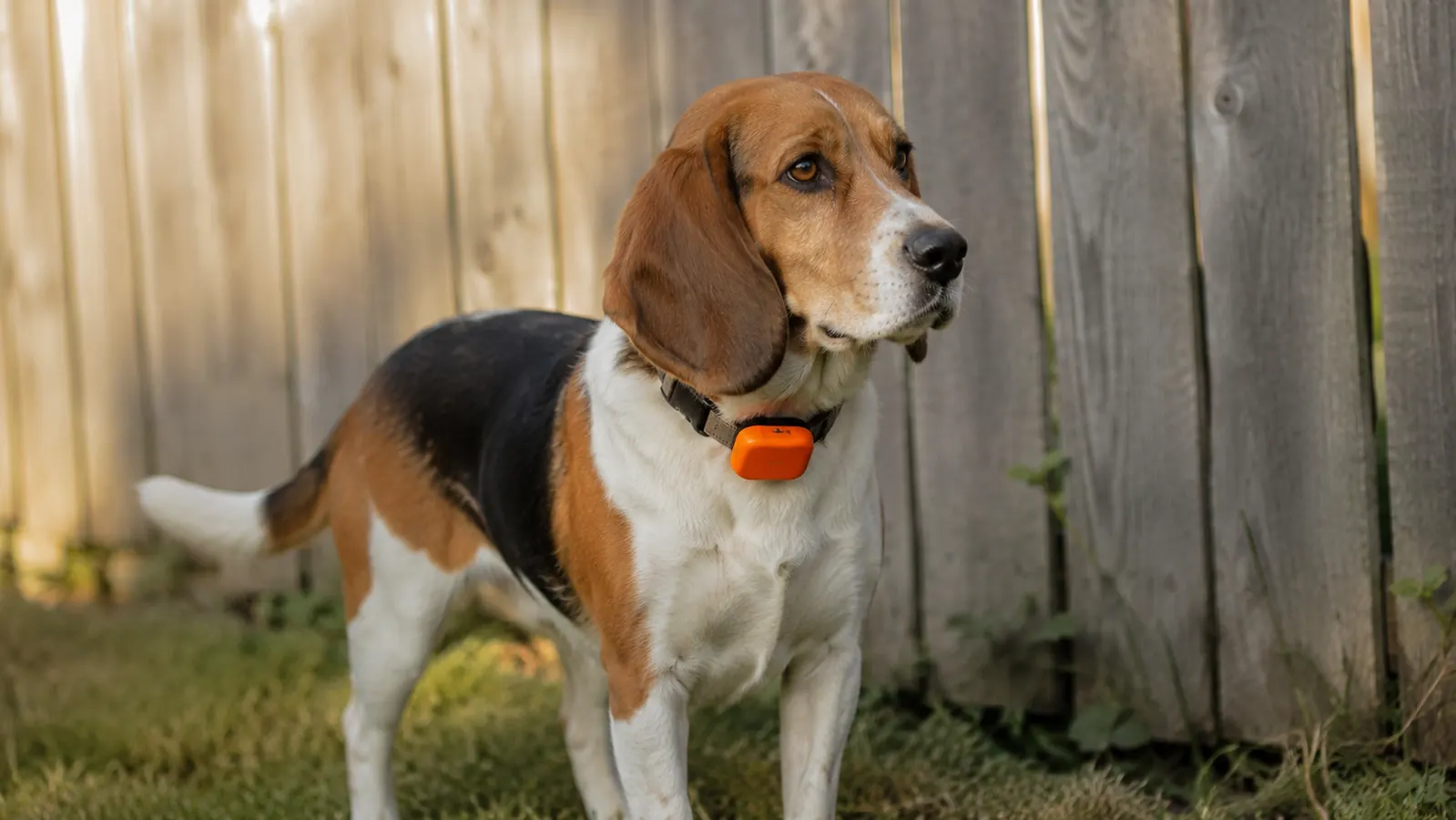
My Beagle, Rosie, has escaped our backyard eleven times in the last year and a half. Not because we have a bad fence. Because she is a Beagle, and Beagles treat every perimeter like a personal challenge. The morning she cleared the gate and disappeared into the neighbors' woods for three hours, I sat in the driveway shaking, driving slow circles through the neighborhood. That was the day I ordered the Tractive Smart Dog GPS Tracker. She was wearing it within 48 hours. That was five months ago, and she has gotten out four times since then. Every single time, I had her location on my phone within seconds.
Before I tell you everything I love about this tracker, I need to say one thing clearly upfront: the Tractive GPS device itself is only part of the purchase. It does not work at all without an active monthly or annual subscription to Tractive's cellular service. The device is hardware only. The subscription, which runs roughly $5 to $9 per month depending on the plan you choose, is what pays for the cellular data that makes live tracking possible. This is not buried in the fine print. Tractive is reasonably upfront about it. But I have talked to two other dog owners who did not realize what they were signing up for until after the device arrived. So: budget for both, and do the math before you buy. With that said, after five months of real use with a dog who actually escapes, here is my honest assessment.
The Quick Verdict
The best real-time GPS tracker I have tested for dogs who actually escape, as long as you go in knowing the subscription is non-optional and battery life in live-tracking mode is short.
Amazon Check Today's Price →If your dog has ever gotten out of the yard, this is the one piece of gear you will not regret buying.
The Tractive GPS tracker has a 4.0 rating across 4,571 reviews. Check the current price and available subscription bundles on Amazon.
Amazon Check Today's Price on Amazon →How I Have Used It for Five Months
Rosie is a four-year-old tricolor Beagle, 24 pounds, and genuinely nose-driven. The moment a scent catches her, every other sense switches off. She has gone over fences, under fences, and through gaps I did not know existed. I clip the Tractive tracker to her collar every morning as part of her routine, the same way I clip on her ID tags. It stays on during walks, backyard time, and car rides. I have not taken it off for an extended period except to charge it.
I run the Tractive app on an iPhone 15 and my partner also has the app on an Android phone. We both get escape alerts at the same time, which matters when I am at work and she is home. During Rosie's four actual escapes since getting the tracker, we were able to pull up her real-time location within about 10 to 15 seconds of opening the app. The longest chase took 22 minutes door-to-door. The shortest was 7 minutes. Previously, the average was over an hour of panicked searching.
I have also used the activity monitoring feature, which tracks daily steps and rest time, and the virtual fence feature, which triggers an alert the moment Rosie crosses a boundary I draw on the map. That alert is what woke us up at 6:40 a.m. on a Saturday when she had slipped through a gap in the fence while we were still asleep. By the time I put on shoes she had only made it to the end of the block.
Location Accuracy: The Number That Actually Matters
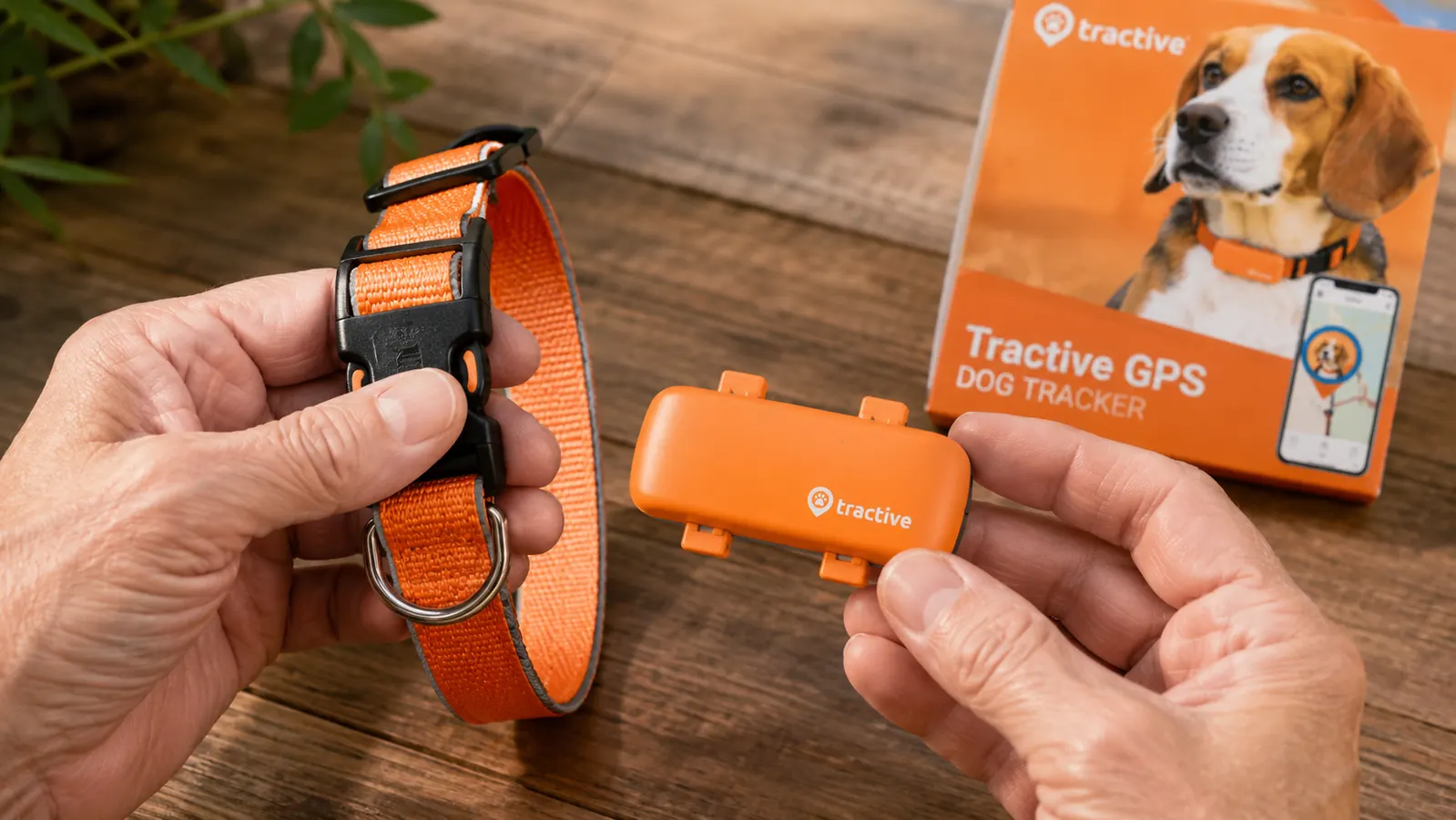
The Tractive uses a combination of GPS, cellular (LTE-M), and Wi-Fi triangulation. In suburban and urban environments with good cell coverage, the accuracy is excellent. In live-tracking mode, the app updates Rosie's position roughly every 2 to 3 seconds. I have walked parallel streets to her location and been within about half a block on the app. That is more than good enough to intercept a 24-pound dog.
Where accuracy gets spottier is in areas with limited cell coverage. My sister lives 45 minutes outside the city and has a similar dog. When she borrowed the tracker for a weekend, she found that updates were slower, 30 to 60 seconds between pings, and once the app showed her dog a quarter-mile from where he actually was. In dense woods or rural areas with only 2G or 3G coverage, the GPS precision drops noticeably. Tractive uses cellular networks, not its own satellite grid, so you are dependent on carrier coverage in your area. Before you buy, check whether your location has decent LTE coverage. The tracker is excellent where cell service is strong and less reliable where it is not.
The longest escape-to-recovery since I got this tracker was 22 minutes. Before the Tractive, the average was over an hour of driving around scared.
Battery Life: Honest Numbers
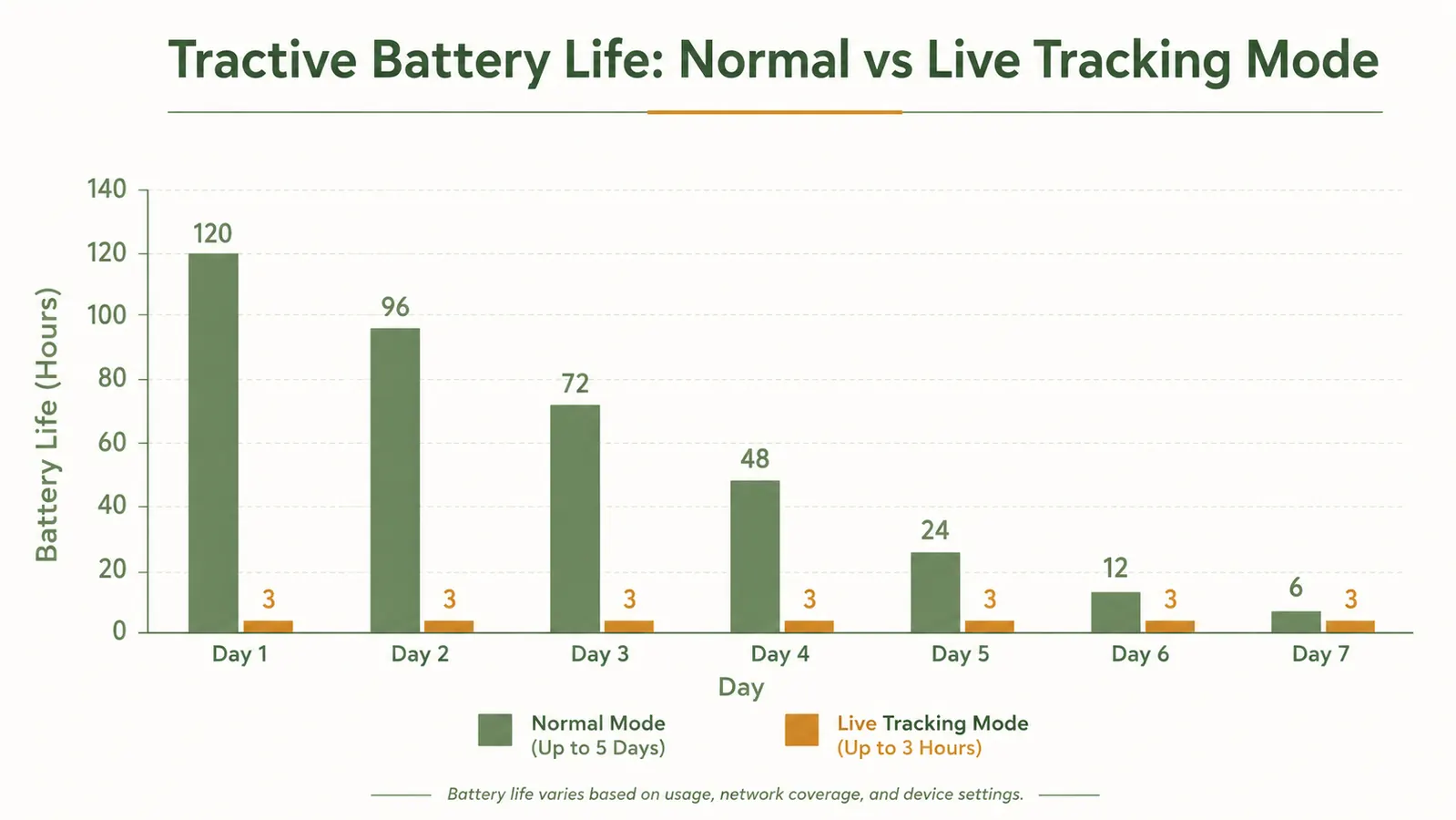
Battery life is the biggest real-world trade-off with the Tractive. In standard mode, which updates location every few minutes, the battery lasts roughly 4 to 5 days on a single charge for me. That matches what Tractive advertises and is genuinely good for a tracker this small.
The catch comes with live-tracking mode, which is what you actually want during an escape. In live-tracking, the device is pinging every 2 to 3 seconds, and the battery drops fast. In my experience, live mode drains the battery in roughly 3 to 4 hours of continuous use. During a normal escape situation where you are tracking for 20 to 30 minutes, this is not a problem. But if you are planning a full day of off-leash hiking and want live tracking the whole time, you will run out of battery. The solution is to leave the tracker in standard mode day-to-day and only trigger live mode when an escape alert fires. The virtual fence feature does this automatically: it switches to live tracking the moment Rosie crosses the boundary, which is exactly when I need it.
Charging takes about 2 hours via the magnetic clip cable. I charge it every Sunday evening and have never had it die on me mid-week. The charging cable is proprietary, which I find mildly annoying since it means one more unique cable to keep track of. Pack it in your dog bag when you travel.
The Subscription: What You Are Actually Paying For
I want to spend a full section on this because it is the most common complaint in reviews and the most common surprise for new buyers. The Tractive device itself does not contain its own satellite receiver that works independently. It works by connecting to cellular networks and routing that data through Tractive's servers to your phone. That cellular connection is what the subscription pays for.
At the time of writing, Tractive offers monthly, annual, and multi-year plans. Monthly is the most expensive per month. Annual brings the per-month cost down considerably. I pay annually. When I do the math, the subscription cost over a year is real money, and it adds meaningfully to the total cost of ownership beyond the device price. That is a fair trade for me personally, given how often Rosie escapes and what the alternative costs are (time, gas, stress, the one time we had to pay a neighbor for keeping her in their yard). But it is a trade-off you should calculate for your own situation before you commit. If your dog rarely gets out and you mostly want a tracker for casual hiking, the ongoing cost might not pencil out the same way.
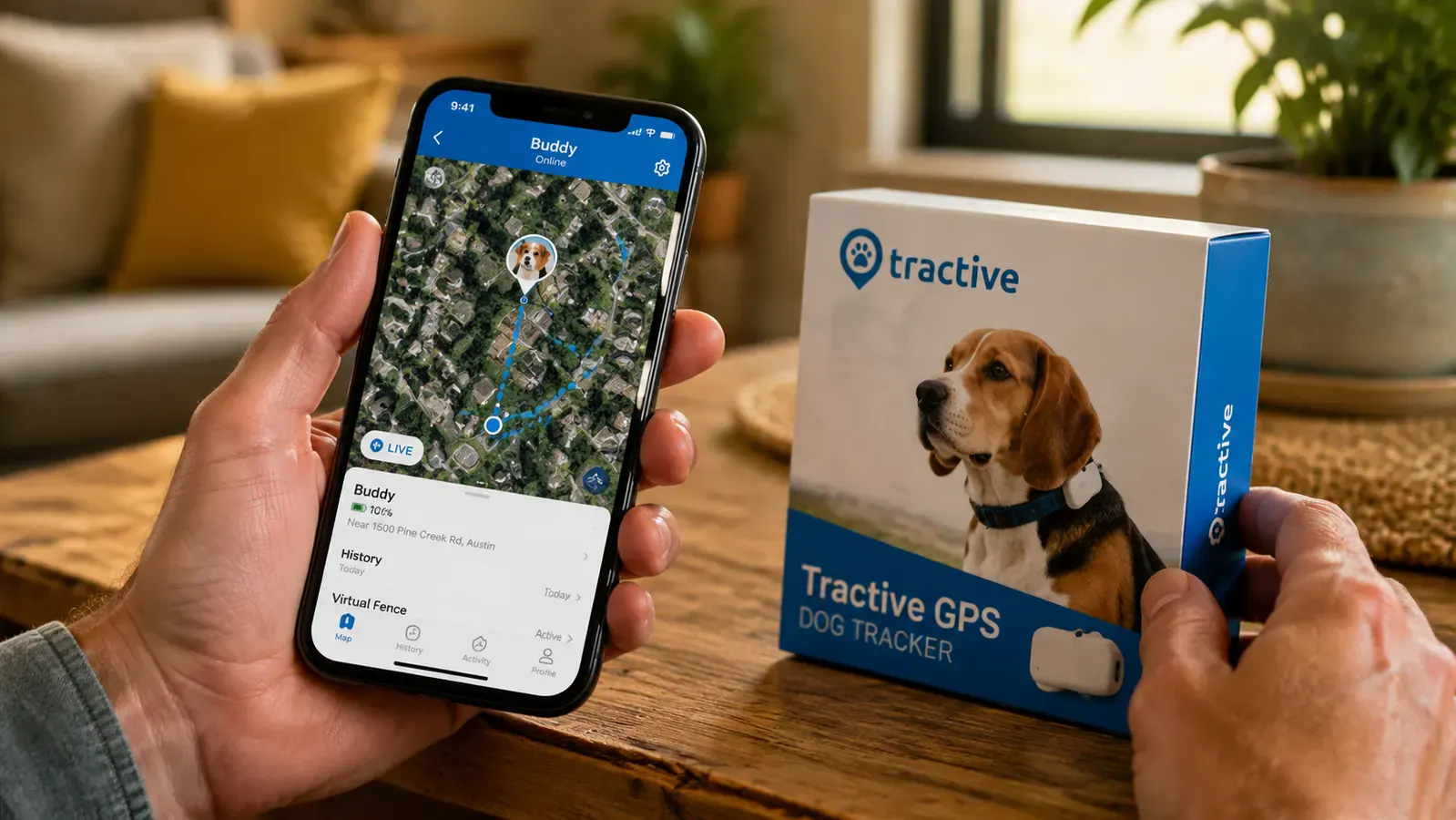
The app itself is solid. It handles multiple dogs (useful if you eventually add a second), shows location history for up to 365 days on premium plans, and lets you share access with family members. My partner and I both get alerts simultaneously without paying for two separate subscriptions. That is a feature I appreciate. Setup took about 10 minutes including app download, account creation, and pairing the device.
Physical Build and Fit
The Tractive tracker is smaller than I expected from product photos. It is roughly the size of a large thumb drive, maybe a little chunkier. On Rosie's 24-pound frame it looks proportionate and does not seem to bother her. Tractive lists it as suitable for dogs over 9 pounds. I would not put it on a very small dog or a cat, but for medium and large breeds it fits well.
The tracker clips onto a standard collar and locks in place with a small slot. It has not fallen off in five months of regular use, including one incident where Rosie got tangled in a bush and I had to physically pull her free. The device is water-resistant rated at IP67, which means it can handle rain and brief submersion. Rosie has waded through a creek wearing it without any issues. I would not leave it underwater for extended periods, but for outdoor daily use it holds up.
What the Tractive Does Not Do Well
Coverage limitations in rural areas are the main functional weakness I have already described. Beyond that, the proprietary charger cable is an inconvenience. The activity tracking data is interesting but not medically meaningful, so do not buy it as a health monitor. The virtual fence alerts fire a few seconds after the dog crosses, not as she is crossing, which is a minor lag baked into how GPS polling works. It has never caused a problem for me in practice, but it is not a real-time electric fence. It is a notification that your dog has left an area.
I also want to flag that the Tractive app occasionally loses contact with the device when Rosie is inside the house and far from a window. This is a known quirk of cellular GPS in buildings. The app shows a last-known location rather than a live one, which is fine since I can see her from where I am sitting. But if you are monitoring a dog in a large indoor facility or basement, expect occasional gaps.
What I Liked
- Live location updates every 2 to 3 seconds in cellular coverage areas
- Virtual fence with instant escape alerts
- Works on both iOS and Android, family sharing at no extra cost
- IP67 water resistance holds up in daily outdoor use
- Compact and lightweight, proportionate on medium dogs
- Activity monitoring included with subscription
- Easy setup, under 10 minutes from box to working
Where It Falls Short
- Mandatory subscription required for the device to work at all
- Live-tracking mode drains the battery in roughly 3 to 4 hours
- Accuracy and update speed drop significantly in rural or low-coverage areas
- Proprietary charging cable is a minor annoyance
- Occasional indoor connectivity gaps in buildings
- Total annual cost (device plus subscription) adds up beyond the sticker price
How It Compares to What Else I Considered
Before settling on the Tractive, I looked hard at the Apple AirTag. It is cheaper upfront and has no subscription. But AirTag works on Bluetooth crowd-detection, not live cellular GPS. In practice, that means your dog's location only updates when another iPhone user is physically nearby her. In the moment Rosie is running through the woods at 6 a.m. with no other iPhone users around, an AirTag tells me nothing useful. I read through enough rescue stories to know that crowd-sourced location is simply not the same tool as cellular live tracking. The Tractive costs more over time. It is also actually in a different category of usefulness for a dog that escapes in real conditions. I cover this comparison in more depth in my separate article on the subject if you want the full breakdown.
I also looked at the Fi Series 3 collar, which has a larger battery and a more refined app. It is a good product at roughly double the Tractive's device cost with a similar subscription model. For my situation and budget, the Tractive hits the right balance. The Fi is worth knowing about if you have a large dog and want a longer between-charge interval.
Who This Is For

The Tractive GPS tracker is the right buy if your dog has actually gotten out of the yard before, if you hike off-leash in areas where your dog could wander out of sight, or if you live in a rural area where a lost dog can cover serious ground fast. It is also a solid choice for multi-person households where two people need to share live location access, since the family sharing feature handles that without extra cost. If your dog stays in a well-fenced yard, never escapes, and you mostly want something for occasional trail hikes, the value proposition is softer and you should do the subscription math carefully before committing.
Who Should Skip It
Skip the Tractive if you live in a rural area with genuinely poor LTE coverage and you need precision location in those specific areas. The technology simply does not perform as well without carrier signal. Also skip it if the idea of a recurring subscription for a pet device bothers you on principle. There is no version of Tractive that works without one, and no workaround. If you want a one-time purchase, an AirTag is the honest alternative, with the real-world limitations that come with it. Finally, if your dog is under 9 pounds or you want to put this on a cat, the form factor is not really designed for that, and there are purpose-built cat trackers better suited to smaller animals.
Five months of escapes, four recoveries, zero panicked hours spent driving blind through the neighborhood.
The Tractive Smart Dog GPS Tracker is available on Amazon. Read the current reviews, check subscription bundle pricing, and confirm your local cell coverage before ordering.
Amazon Check Today's Price on Amazon →