
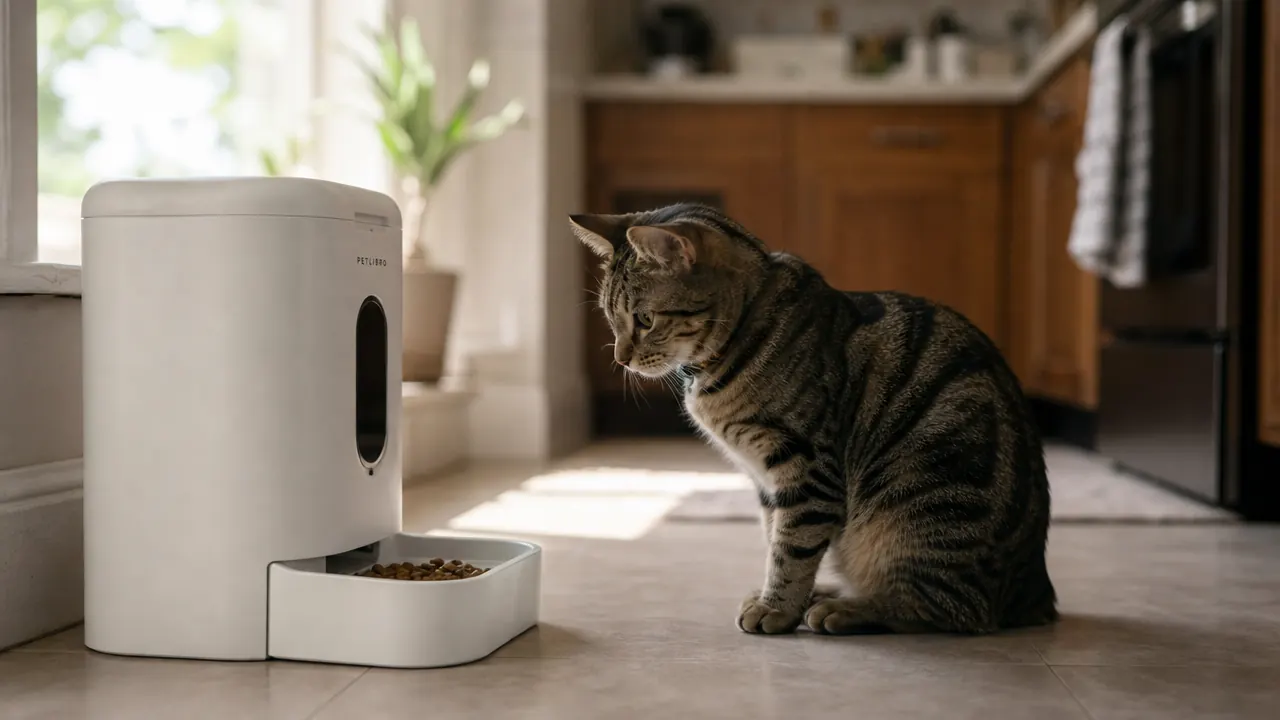
My cat Margot used to act like she was starving from the moment my alarm went off until the second I poured kibble into her bowl. Free-feeding had been the plan when she was a kitten, and it had turned into a disaster by the time she was four years old and carrying two extra pounds her joints did not need. My vet was kind about it but direct: the bowl going down once in the morning and once at night, measured out, no exceptions. The problem was that the moment I was in the kitchen, Margot was yelling at my feet, and I was caving. I needed something that removed me from the equation entirely. That's what an automatic feeder actually does, and it's the part nobody talks about. It's not just a timer. It's a way to take human inconsistency completely out of your pet's portion routine.
The PETLIBRO RFID Automatic Cat Feeder is the unit I landed on after trying two cheaper models that jammed, poured double portions randomly, and drove Margot into a frenzy of uncertainty. The PETLIBRO uses a collar sensor so it only opens for the pet wearing the paired tag, which matters if you have more than one animal in the house with different calorie needs. Even if you have a single pet, the process below applies to any programmable auto feeder. These are the exact steps I used, and the same ones I've walked three friends through since then.
Still hand-feeding? Your pet's portions are probably wrong every single day.
The PETLIBRO RFID Automatic Cat Feeder programs up to ten meals daily with precise portion sizes down to the tsp level, with a collar sensor that locks each serving to the right pet. Check today's price on Amazon before you read another article about your overweight cat.
Amazon Check Today's Price on Amazon →Step 1: Get Your Vet's Actual Daily Calorie Target Before You Touch the Feeder
This step sounds obvious, but almost everyone skips it. They set up the feeder first and then guess at portion sizes. The problem is that the feeding guides on the back of kibble bags are written by the pet food company, and they consistently overstate the recommended amount because it sells more food. Your vet can give you a target in calories or in cup equivalents based on your specific pet's age, breed, current weight, and activity level. Get that number before you do anything else.
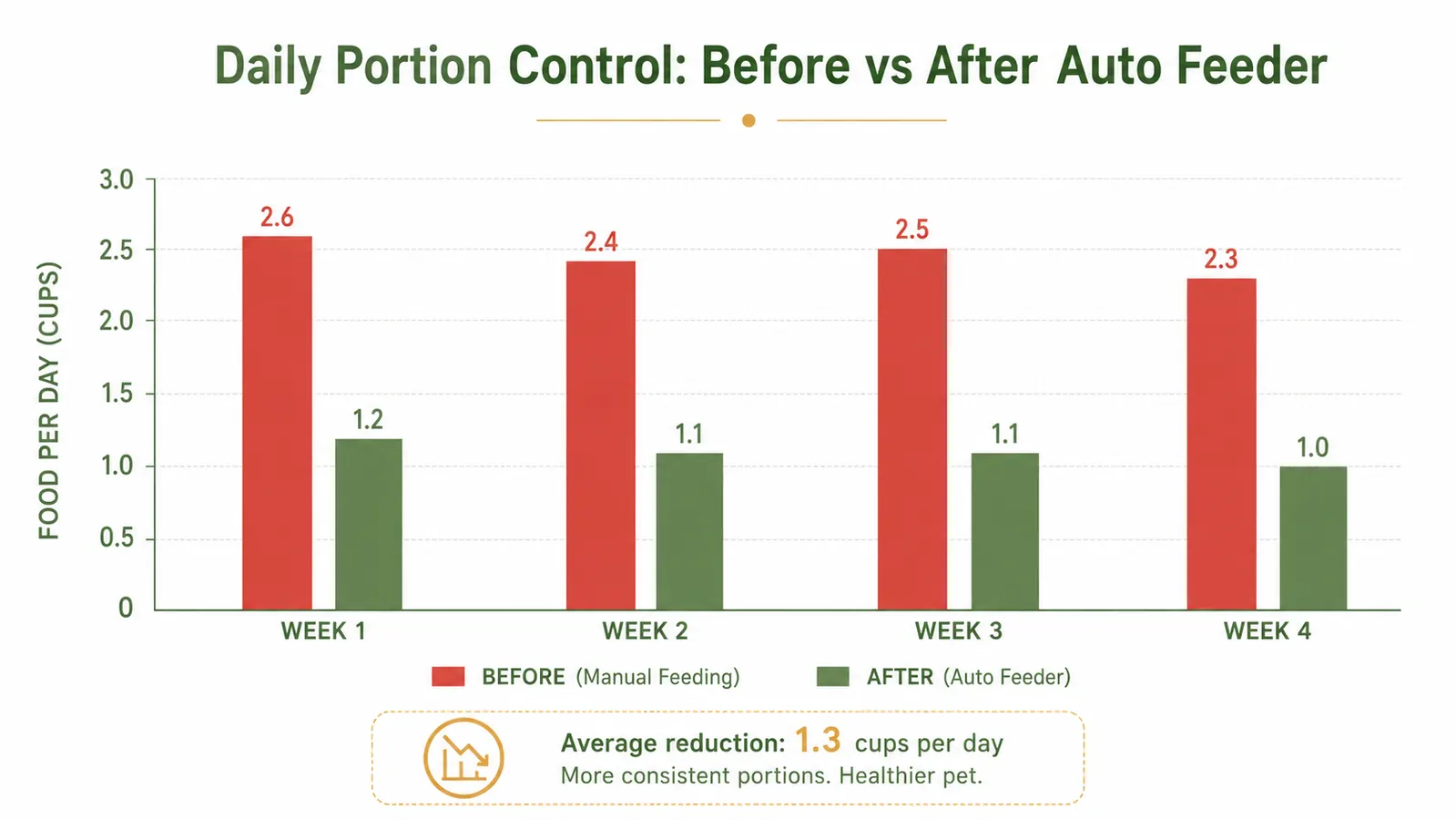
For Margot, the target was 180 calories per day, which worked out to about two-thirds of a cup of her regular dry food split across three meals. That's meaningfully less than the bag suggested for her weight, and it's the number that actually moved the scale at her next checkup. If you have a dog, the math is different but the principle is the same. A 50-pound moderately active dog might need anywhere from 800 to 1,000 calories, and your vet can narrow that range based on whether your dog is losing, maintaining, or gaining. Write the target down. You'll need it for Step 3.
One thing worth noting: if your pet has been free-fed or given large irregular portions for a long time, their stomach has stretched to expect volume it doesn't need. The vet-recommended amount may feel shockingly small for the first week. That's normal. The adjustment period is real, and knowing it's coming keeps you from second-guessing yourself and adding a little extra to make them 'feel better.'
Step 2: Choose the Right Feeder for Your Setup Before You Commit
Not every automatic feeder is right for every household, and getting this wrong means returning the unit in two weeks. The two things that matter most are the number of animals you're feeding and the type of food. If you have a single cat or dog eating dry kibble, a standard timed portion feeder will work fine. If you have two pets with different calorie needs, you need something with access control, like the PETLIBRO RFID model, which uses collar-mounted tags to open only for the right animal. Without that, your leaner pet will eat the restricted pet's food the moment you turn your back.
Wet food is a separate conversation. Most gravity-style and timed-dispenser feeders are not built for wet food because it spoils in the bowl within hours. There are a handful of refrigerated auto feeders designed for wet food, but they're a different product category entirely. If your pet is on wet food only, an ice pack tray feeder can work for same-day meals, but for a multi-meal schedule across a full work day, you're better off transitioning to at least a mixed wet-dry diet or consulting your vet about a full dry food option. The steps below assume dry kibble or small hard treats.
Step 3: Program Your Meal Schedule Before Your Pet Sees the Feeder
Set the feeder up and program it in a room the pet doesn't have access to yet. This matters more than it sounds. If you're fumbling with the app or the control panel while your cat is headbutting the unit and your dog is spinning circles, you'll make errors in the portion settings that you won't catch until you've been over- or under-feeding for three days. Take twenty quiet minutes with the feeder manual, the PETLIBRO app if you're using one, and your vet's calorie target from Step 1.
Divide the daily portion across however many meals you're scheduling. Three meals tends to work well for most cats because it spaces hunger signals more evenly than two, and dogs generally do well on two to three meals depending on size and breed. Set each meal portion carefully. The PETLIBRO feeder measures in increments as small as one portion unit (roughly one-fifth of a tablespoon), which gives you real precision. Run a test dispense into an empty bowl and weigh it on a kitchen scale to confirm the setting matches what you intend. Repeat for each meal slot.
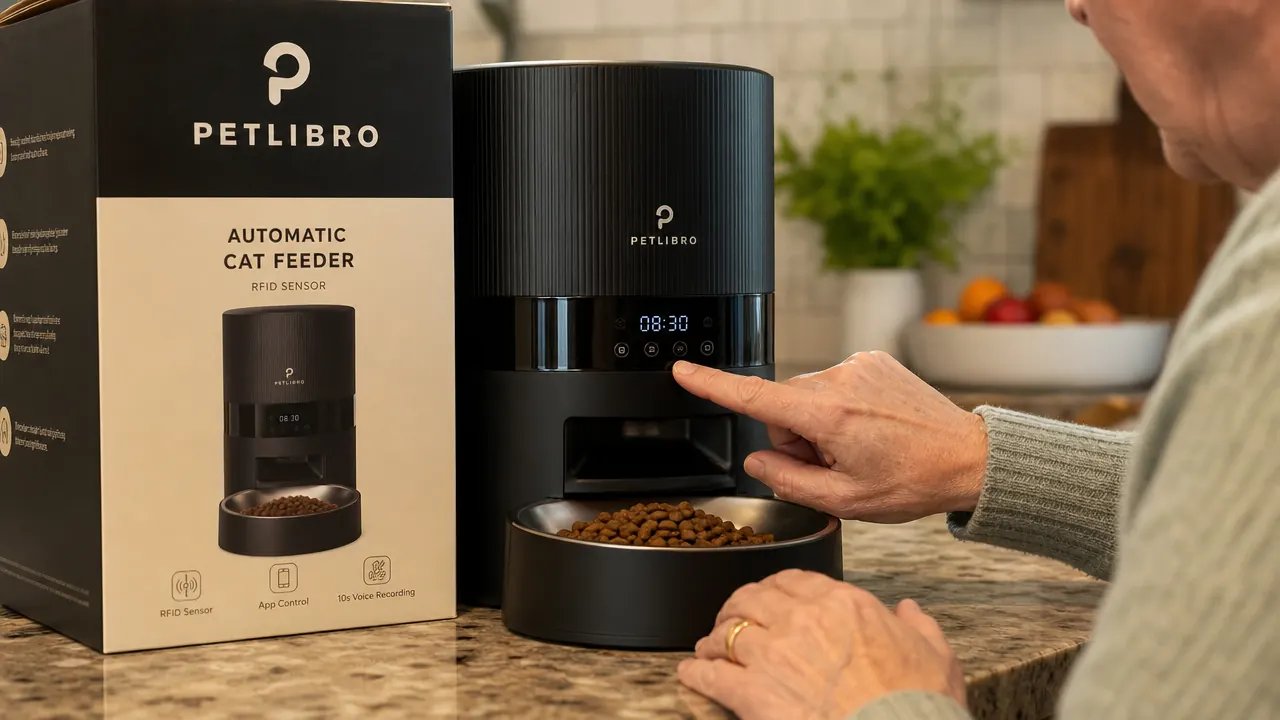
Step 4: Introduce the Feeder Slowly So Your Pet Accepts It
Put the feeder in the spot you plan to keep it and let your pet sniff it, push it around, and investigate it for at least twenty-four hours before it dispenses a single meal. Plug it in, let the hum of the motor become background noise in the house. If your pet is skittish about appliances, put a couple of their kibble pieces near the base so they associate it with something positive before it startles them with a motor sound at 7 a.m.
When you run the first live meal through it, stay nearby but don't hover. Some pets take to it immediately because food came out and that's all they needed to know. Others, especially cats who have been hand-fed or voice-signaled for years, will sit two feet away and stare at the bowl suspiciously for several minutes. Give it time. Don't add a second portion because they walked away the first time. If your pet skips one automated meal, they will eat the next one. Hunger is a reliable motivator and the adjustment window for most pets is three to five days.
For RFID feeders, the collar tag introduction takes one extra step. The pet needs to get comfortable approaching the feeder while wearing the tag before the association clicks. Practice by placing treats in or near the feeder bowl while the pet is wearing the collar. After two or three days of that, switch to the programmed schedule. Most cats and small dogs adapt without incident. Larger or more stubborn dogs may take a full week to stop trying to muscle the lid open and accept that the feeder's timing is non-negotiable.
Step 5: Eliminate All Other Food Access Points Completely
This is where most people fail. They set up the automatic feeder, run it for a week, and then wonder why their cat hasn't lost any weight. The answer is almost always a second food source they forgot to remove. A bowl of kibble left out on the counter 'just in case.' Treats given freely throughout the day without counting them against the daily calorie total. A dog that's been helping himself to the cat's food because the bowls are at floor level. A family member who feels too guilty watching the pet beg and quietly tops up the bowl.
Pull all free-access food sources the day the feeder goes live. Pick up spare bowls. Put treats in a cabinet and account for them in the daily total if you give any. If you have multiple people in the household, have a direct conversation about not supplementing the feeder, because well-meaning family members are the single biggest reason portion control fails. I put a sticky note on our kibble container for the first two weeks that said 'feeder is already set, don't add more.' Felt silly. Worked perfectly.
What Else Helps
The feeder handles timing and portions, but two other changes made a real difference alongside it. First, I switched to a slow-feeder insert for Margot's bowl. She was eating each dispensed meal so fast she'd occasionally vomit, which is common in cats who have trained themselves to eat as quickly as possible because they weren't sure when food would appear next. A maze-style slow feeder insert slows consumption and gives the stomach time to register fullness before the bowl is empty. Second, I added a midday enrichment session: five minutes of wand play or a puzzle toy right before her afternoon meal. The mental and physical activity reduced her food-focused anxiety considerably within the first two weeks. A pet that's been hunting or playing doesn't hit the feeder in the same frantic state as one who's spent eight hours doing nothing but waiting.
The feeder didn't just fix Margot's portions. It fixed my guilt. Once I trusted the machine, I stopped second-guessing myself every time she meowed at me near the kitchen. That's the part nobody advertises.
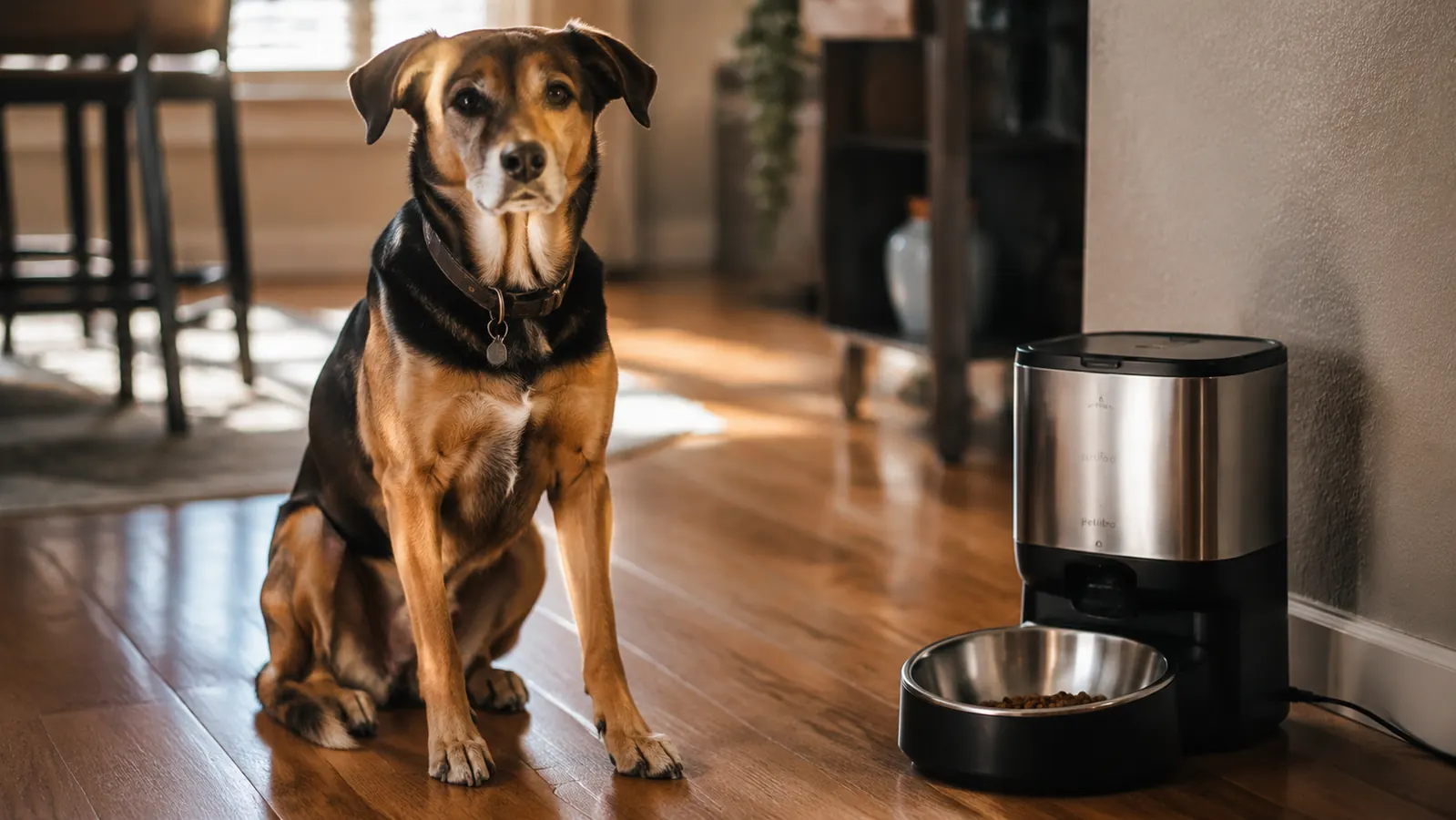
For dogs specifically, puzzle feeders and snuffle mats work well in parallel with a timed auto feeder. Dogs are wired to work for food, and a dog who eats from a lick mat or snuffle mat is genuinely more satisfied by the same portion than one eating from a flat bowl in 45 seconds. It slows ingestion and engages the foraging instinct, both of which reduce post-meal begging. You don't need expensive equipment for this. A muffin tin with kibble pressed into the cups, turned upside down with a rubber mat over it, does the same job as a premium snuffle mat.
Ready to hand portion control over to something that doesn't cave when your pet gives you the look?
The PETLIBRO RFID Automatic Cat Feeder programs up to ten meals a day with collar-sensor access control for multi-pet homes. It's the feeder I've run daily for months and recommended to every pet owner I know dealing with an overeater. Check today's price on Amazon and see if it fits your situation.
Amazon Check Today's Price on Amazon →